
When History Rhymes on Purpose
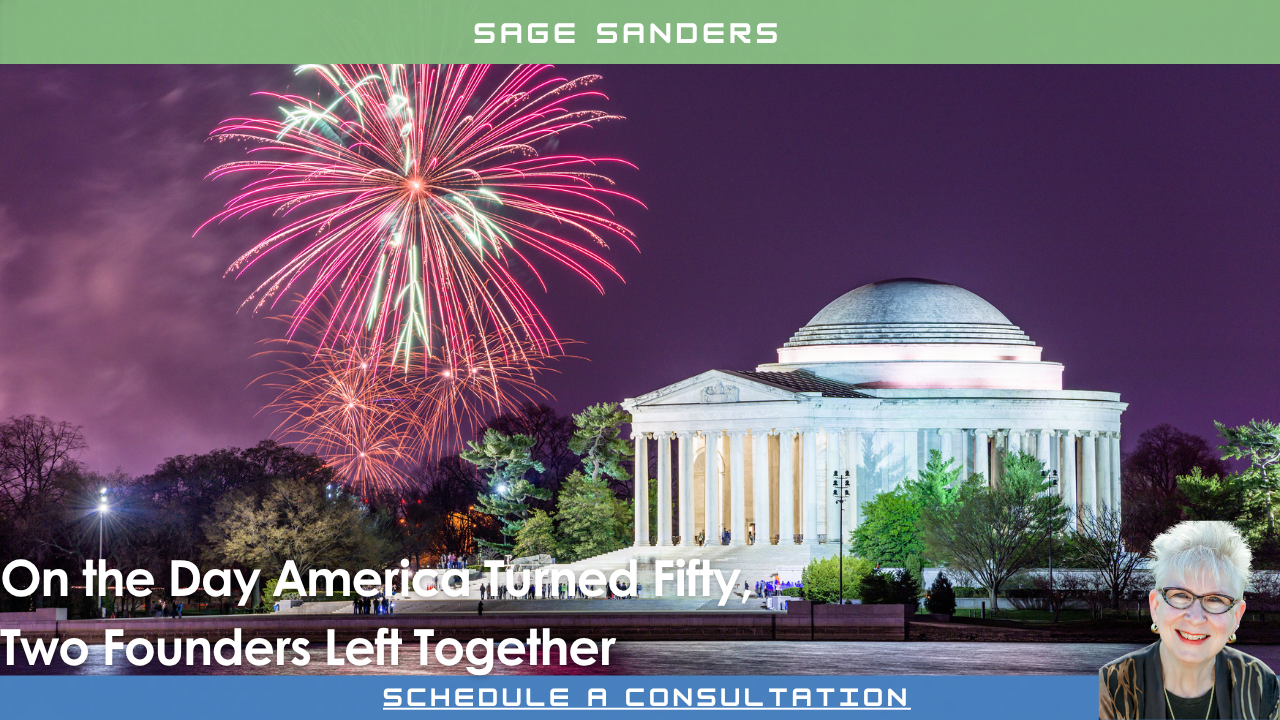
On July 4, 1826, while Americans were lighting fireworks to celebrate fifty years of independence, two of the men who built it were dying.
Thomas Jefferson passed away at Monticello, his beloved Virginia home, just before noon. John Adams died at his home in Quincy, Massachusetts, hours later, as the celebrations outside reached their height. His last words were: "Thomas Jefferson survives."
He was wrong about the fact. He was not wrong about the legacy.
Both men lived to see the nation they had argued, bled, and nearly broken their friendship over turn fifty years old. Both men died on the exact anniversary of the document that defined them. The odds of that happening are so small they barely have a name. The country celebrated with fireworks, not yet knowing it was also marking a farewell.
I think about this every Fourth of July.
Not because it's a great trivia answer, though it is. But because there's something in it that has always moved me. Two men, former rivals and then reconciled friends, who spent their final decades writing letters to each other across the miles between Virginia and Massachusetts, both slipping away on the same morning the country turned fifty. As if they had somewhere else to be, together, once the work was done.
A Home Is Not an Asset
Jefferson built Monticello over more than forty years of his life. He redesigned it constantly, obsessively, the way people do when a place is not just a home but an expression of who they are still becoming. He died in those rooms. He is buried on that land. The house outlasted him by two centuries and is still standing.
That is what I mean when I say a home is not an asset. It's the container for a life. Many times for more than one.
The decisions we make about where to live, what to invest in, when to simplify and when to grow, these are not financial decisions with emotional side effects. They are legacy decisions with financial components. There’s a difference, and most people feel that difference later, long after the transaction is closed. Most people treat them the other way around anyway, and they wonder afterward why something that checked every practical box still felt incomplete.
The Quality of a Decision Matters
Jefferson and Adams were not cautious men by nature. They signed a document that, had things gone differently, would have meant execution for treason. They did it anyway, because they could see what they were building even when no one else could. The outcome was not guaranteed. The decision still had to be made.
I am not comparing buying a home in Snohomish County or King County to founding a republic. But I’m saying that the quality of a decision matters. The willingness to ask what you are actually building, not just what you are buying, matters. Whether you’re a first-time buyer making the most significant financial commitment of your life, a downsizer asking what this next chapter should actually feel like, or an investor thinking carefully about what you want to hand forward, the question underneath all of it is the same.
What do you want to still be standing when you’re gone?
How You Make Decisions This Size
Some people lead with data when that question gets hard. Some lead with relationships, making sure everyone in the family is at peace before they move. Some move slowly and carefully, needing trust before they take a step. Some see the strategic long arc immediately and position accordingly. And some simply wait until the timing feels right inside, no matter what anyone else thinks of the moment.
All of those are real ways to make real decisions. All of them are right. Knowing which one is yours changes everything about how you move through a choice this significant.
If you’re in or approaching a season of simplifying, and you’d like a practical place to start, the Downsizer Guide is available for you. It’s a quiet and useful resource built for exactly this kind of transition.
Every major life transition involves different emotional, financial, and decision-making styles. If you’d like deeper clarity around how you naturally make important decisions, I’d invite you to take the two-minute ABCST Decision-Making Assessment. I personally review every response and provide thoughtful guidance tailored to you.
If you’re ready to talk through your next step, I’d be glad to connect. Schedule a consultation with me directly, no pressure, just a real conversation. What’s your biggest concern today?
I share this because better decisions build better lives.
Coldwell Banker Danforth | Sage LifeWorks
[email protected]
Text: 425-333-1315 | Call: 206-478-7333
sagesanders.com
Check out this article next